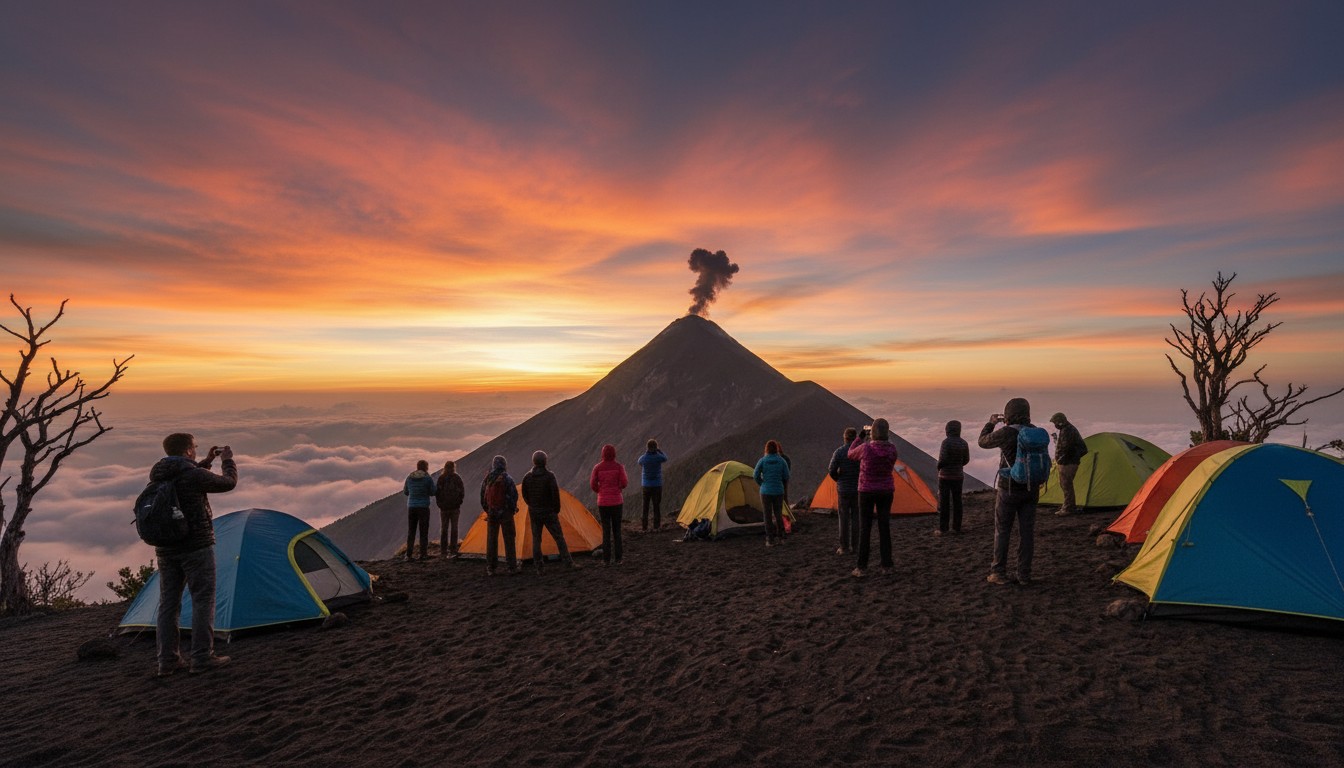
Antigua is swarming with agencies promising the moon. Most just cram you in a beat-up van and hope for the best. If you actually want to enjoy this trek without fearing for your safety or freezing to death—be picky.
Wicho & Charlie’s is the heavy hitter. They run a massive operation, famous for their A-frame cabins which look great on Instagram. It’s a social vibe. Lots of backpackers, vegan food that’s surprisingly edible, and a solid safety record. The catch? It’s crowded. You’re basically hiking in a conga line.
For the serious adventurers, OX Expeditions is the move. These guys are mountaineers. They don’t coddle you. But they have the best gear and guides who actually know wilderness first aid. Feels less like a tourist trap and more like a legit expedition.
If you want to support locals directly, look up Soy Tours. Run by a local family from La Soledad village. The gear isn’t brand new North Face stuff, but the food is homemade Guatemalan goodness. The guides grew up on that volcano. It feels authentic. Just don’t expect a website that works flawlessly.
Compare Luxury Glamping vs. Budget-Friendly Group Hikes
Here’s the thing about “luxury” on a volcano. It’s relative. You are still pooping in a hole in the ground.
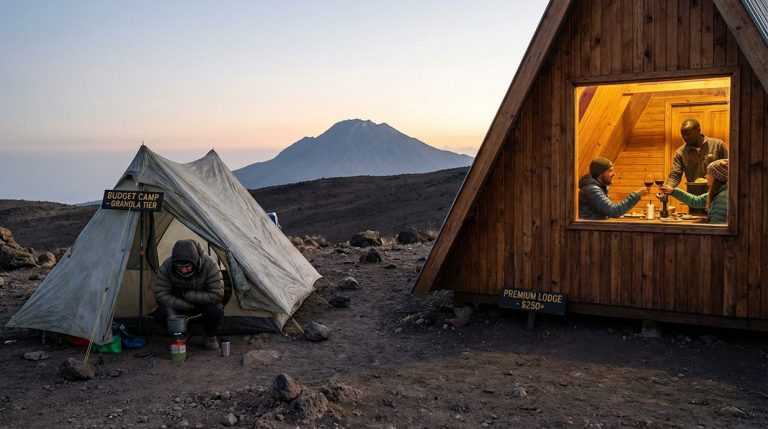
But the difference between a $50 budget tour and a $120+ glamping option is sleep. On a budget tour—like the ones sold by random hostels—you get a thin tent and a sleeping bag used by three thousand other sweaty people. When the wind hits 40mph at 2 a.m., that tent flaps like a machine gun. You won’t sleep. You’ll just lie there, shivering. Regretting being cheap.
The “glamping” options from Wicho & Charlie’s or CA Travelers put you in wooden A-frame cabins. They block the wind. Raised platforms. Some even have heavy blankets on top of the sleeping bags. It ain’t the Four Seasons, but when the wind is howling, that plywood cabin feels like a 5-star hotel. Pay the extra cash. Your sanity is worth it.
Physical Prep: How to Train (Because “Being Fit” Isn’t Enough)
Let’s be real—this hike humiliates people. You are gaining over 5,000 feet (1,500+ meters) of elevation in roughly 4 to 6 hours. It’s not a walk. It’s a vertical trudge through deep sand.
To prepare, simulate the “suck.”
- StairMaster is King: Don’t just run on a flat treadmill. Do 45-60 minutes on the stair machine.
- Weighted Packs: Train with a backpack. Throw 15lbs of books in a bag and find a hill. Your lower back needs to get used to the drag.
- Squats and Lunges: Your quads act as brakes on the way down. If they’re weak, your knees will take the beating.
Detailed Itinerary: From Antigua Pickup to Sunrise Summit
7:00 AM. Chaos starts. You pile into a shuttle or a chicken bus in Antigua, jamming knees against the seat in front for an hour-long drive to La Soledad.
The hike starts immediately. No warm-up. You’re walking up steep, loose farmland in blazing sun. Dust is everywhere. You’ll choke on it. This first hour is the “widow maker” – it breaks people mentally before they even hit the trees.
The Four Zones of Hell (and Beauty):
- Farmland: Steep, dusty, hot cornfields. Hardest part mentally because you aren’t even on the “mountain” yet.
- Cloud Forest: Suddenly, it’s green. Massive trees, moss hanging everywhere, temperature drops. Listen for birds… this is a biodiversity hotspot. Moody. Beautiful.
- High Alpine: Trees thin out into “goblin forest”—gnarled old pines. Views open up.
- Volcanic Scree: Near the top, it’s just black rock and ash. Looks like Mars.
Around noon, you stop for lunch. Usually a burrito or sandwich that tastes like the best meal of your life because you’re starving. Then up into the cloud forest. Air gets thin. Trees get spooky.
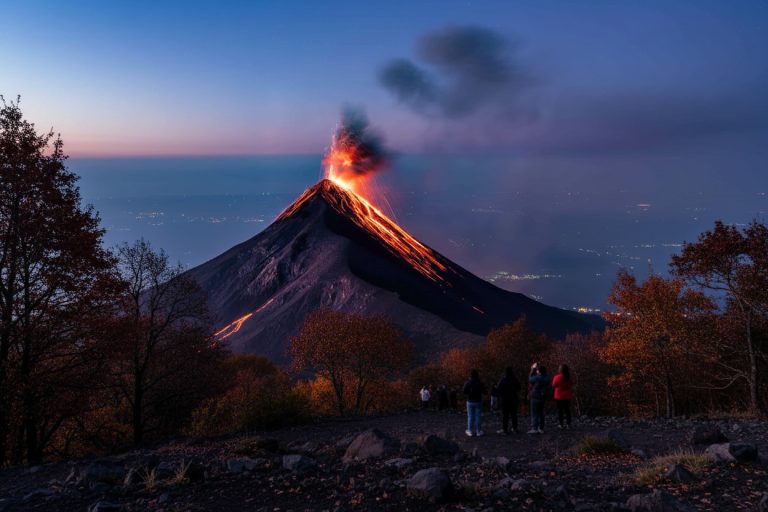
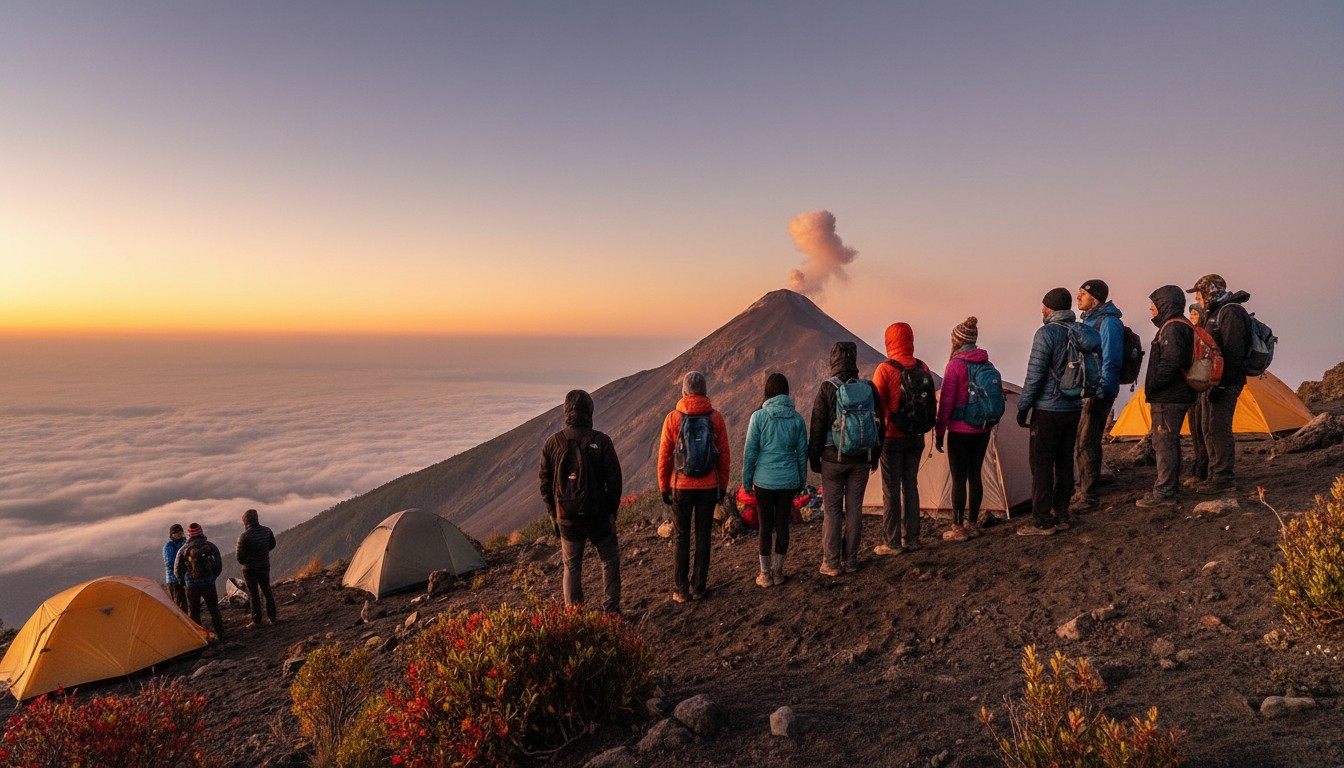
You hit Base Camp (approx. 3,600m) around 4:00 PM. Golden hour. You sit there, exhausted, drinking hot chocolate while Volcán Fuego explodes right in front of your face. It shakes the ground. Terrifying. Beautiful.
Photography Guide: Capturing the Lava
You didn’t hike this far for a blurry iPhone photo. Fuego puts on a show, but capturing it is tricky.
- The Gear: You need a tripod. If you don’t have one, rest your camera on a rock, but a tripod is better.
- The Settings: You want a long exposure to capture lava streaks. Set shutter speed to 10–20 seconds. Aperture wide open (f/2.8 or f/4). ISO around 800–1600.
- The Cold Factor: Cold kills batteries. Keep spares inside your jacket, against your body heat, until the moment you use them. Leave them in your bag and they will be dead by midnight.
- Focus: Auto-focus won’t work in the dark. Switch to Manual Focus and set it to infinity (or zoom in on the volcano’s silhouette during the day and tape the focus ring).
Dinner is served around a campfire. Then you try to sleep.
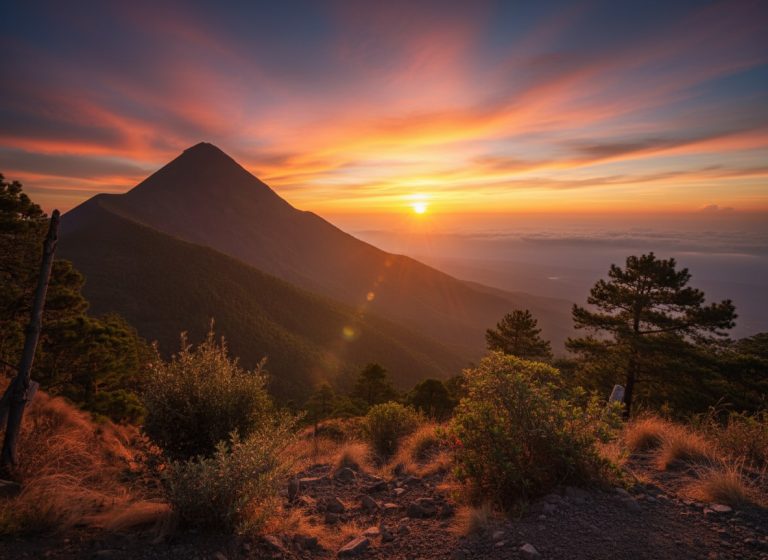
4:00 AM. Wake up call. Pitch black and freezing. You turn on your headlamp and start the summit push. Only an hour, but it’s straight up through deep volcanic scree. Two steps up, one step back. You reach the top just as the sun breaks over the horizon, lighting up the line of volcanoes all the way to Lake Atitlán.
Then you run down. Literally run. You slide down the volcanic ash like you’re skiing. Takes 3 hours to get back to the bus. Your quads will never forgive you.
The “Fuego Add-On”: Is the Extra Volcano Hike Worth the Effort?
Okay, real talk.
You get to Base Camp. Dead tired. Legs are jelly. And then the guide asks, “Who wants to hike Fuego?”
This is the famous add-on. An extra 3-4 hours of hiking after you’ve already climbed Acatenango. You hike down into the saddle between the two volcanoes (La Horqueta) and then straight up the flank of the active one.
The Geology Check:
Why is this happening? You are standing between a dormant giant (Acatenango) and an active monster (Fuego). Fuego is a “Strombolian” volcano. It spits basaltic lava constantly. You are hiking onto a living geologic vent. It rumbles like a jet engine taking off next to your ear.
Is it worth it? Yes.
Will you want to die? Also yes.
It is physically brutal. You do this hike in the dark, often with wind whipping ash into your eyes. But standing on that ridge while lava sprays into the sky above you… it’s a spiritual experience. If you have any gas left in the tank, do it. If you’re already vomiting from altitude, skip it. Watch from camp. No shame in that.
Essential Packing List for International Hikers: What to Bring vs. Rent
Americans always underestimate the cold. “It’s Guatemala,” they say. “It’s the tropics.”
Dude. You are at 13,000 feet. It snows up there.
Bring from home:
- Hiking Boots: Do not wear Nikes. You need ankle support and grip. The volcanic scree destroys sneakers.
- Merino Wool Socks: Cotton kills. If your feet get wet and cold, you’re done.
- A Buff/Scarf: The dust on the way up is like breathing sandpaper. Cover your face.
- Headlamp: Don’t rely on your iPhone flashlight. You need hands free for the scramble.
- Power Bank: Your phone will die in the cold. Bring backup juice.
- Cash: For tips, bathroom fees at the start (Q5), and renting a walking stick.
Rent locally (Most agencies offer this for cheap):
- Heavy Jacket/Parka: Unless you want to lug a winter coat to Central America, just rent one for $5.
- Hiking Poles: Essential. Non-negotiable. Save your knees on the descent.
- Gloves and Hat: Even if you think you’re tough.
How to Prevent Altitude Sickness: Acclimatization & Health Tips
Antigua is at 1,500 meters. Acatenango is nearly 4,000. That jump is enough to wreck you.
I’ve seen fit marathon runners crying in the fetal position at Base Camp because they flew in from Miami that morning and tried to hike. Don’t be that guy. Spend at least two days in Antigua before the hike. Walk around, drink coffee, let your blood thicken up.
Hydration is the cheat code. You need to drink 3-4 liters of water on the hike. It’s heavy to carry, but dehydration makes altitude sickness ten times worse.
Drugs? Maybe. Acetazolamide (Diamox) helps, but you need a prescription and have to start taking it before you ascend. Ibuprofen is good for the headache that will inevitably hit you at 3,500 meters. If you start feeling dizzy or nauseous, tell the guide immediately. There’s no glory in pushing through cerebral edema.
Best Time to Visit: Weather Patterns and Visibility by Season
Guatemala has two seasons: Dry and Wet.
Dry Season (November – April): This is prime time. Views are crisp. You can see the Pacific Ocean. January and February are the clearest months, but also the coldest. We’re talking below freezing at the summit.
Wet Season (May – October): It’s a gamble. You might hike for six hours in pouring rain only to stare at a grey wall of fog at the top. Miserable. But, if you get lucky, the clouds break and you’re floating above a thunderstorm while the volcano erupts. Dramatic – but risky.
If you go in June or September, you must have top-tier rain gear. Not a poncho. Real Gore-Tex.
Booking Guide: Reserving Online in Advance vs. Local Deals
If you’re a planner, book online via Viator or the operator’s direct website a few weeks out. Crucial for high season (Dec-March). The cabins at Wicho’s or the good spots with OX sell out. You pay a premium—maybe $10-$20 more—but your spot is guaranteed.
If you’re a dirtbag backpacker counting every Quetzal, just show up in Antigua. Walk into a travel agency on 6th Avenue the day before. You can haggle. You might snag a spot for $45. Just know that you might end up with a company that cuts corners on food or transport.
The Ethics of Porters: Why You Should Hire One
There is a strange “macho” culture among some hikers who think hiring a porter is cheating. Ignore that.
For about Q200 ($25 USD), a local from La Soledad will carry your heavy pack (sleeping bag, 4 liters of water, winter clothes) up to base camp.
Why do it?
- Local Economy: Direct injection of cash into rural communities that maintain the trail. Puts food on tables.
- Enjoyment: Hiking with a 10lb daypack vs. a 45lb rucksack is a completely different experience. You can actually look around and enjoy the cloud forest instead of staring at your boots, gasping for air.
- Success Rate: If you aren’t an elite athlete, carrying the heavy pack significantly increases your chance of failing to reach the top.
Hire the porter. Be nice. Tip them.
Safety, Tipping, and Logistics: A Complete FAQ for Americans
Is it safe?
Generally, yes. The biggest danger isn’t bandits—it’s hypothermia and twisted ankles. Guides carry radios. Stick with the group.
How much do I tip?
These guides haul 50lb packs up a volcano three times a week. They are machines. Tip them well. 50-100 Quetzales (approx $7-$13 USD) per hiker is standard. Hand it directly to the guide, not the agency owner.
What about the bathroom situation?
There are “toilets” at Base Camp. I use quotes because it’s usually a hole with a seat over it. Bring your own toilet paper. Bring hand sanitizer. At the summit? The world is your toilet. Find a rock.
Can I do this solo?
Technically, yes. But it’s not recommended for safety reasons. If you twist an ankle alone in the scree, you’re in big trouble. Also, the trail forks in the farmland and it’s easy to get lost. Stick to a tour or hire a private guide.
Post-Hike Recovery: Where to Unthaw in Antigua
When you get back to Antigua around 11:00 AM the next day, you will be dirty. Dusty. Sore. Here is the recovery playbook:
- Santa Teresita Hot Springs (Kawilal Spa): Located in nearby Amatitlán. Thermal water circuit powered by the Pacaya volcano. You cycle through hot and cold pools. Heaven for destroyed muscles.
- The Massage: Go to Healing Hands or similar spots in Antigua. Ask for a “Deep Tissue” or “Sports Massage.”
- The Meal: You burned about 4,000 calories. Go to Rincón Típico for a massive plate of roasted chicken and potatoes, or hit up Tokbaru for a giant bowl of curry. You earned it.